A Task Taxonomy for Edge and Trail Bundling
Markus Wallinger (Technical University of Munich), Stephen Kobourov (Technical University Munich)

Jump to Discussion
Presentation
- Session
- Connecting the Dots
- Time
- Wednesday, Nov 11, 13:27 – 13:36 (US/Eastern) · session 13:00 – 14:30
- Room
- Hall Essex north
Links
Sign in to access the Paper PDF.
- Supplemental Material(opens in new tab)
Abstract
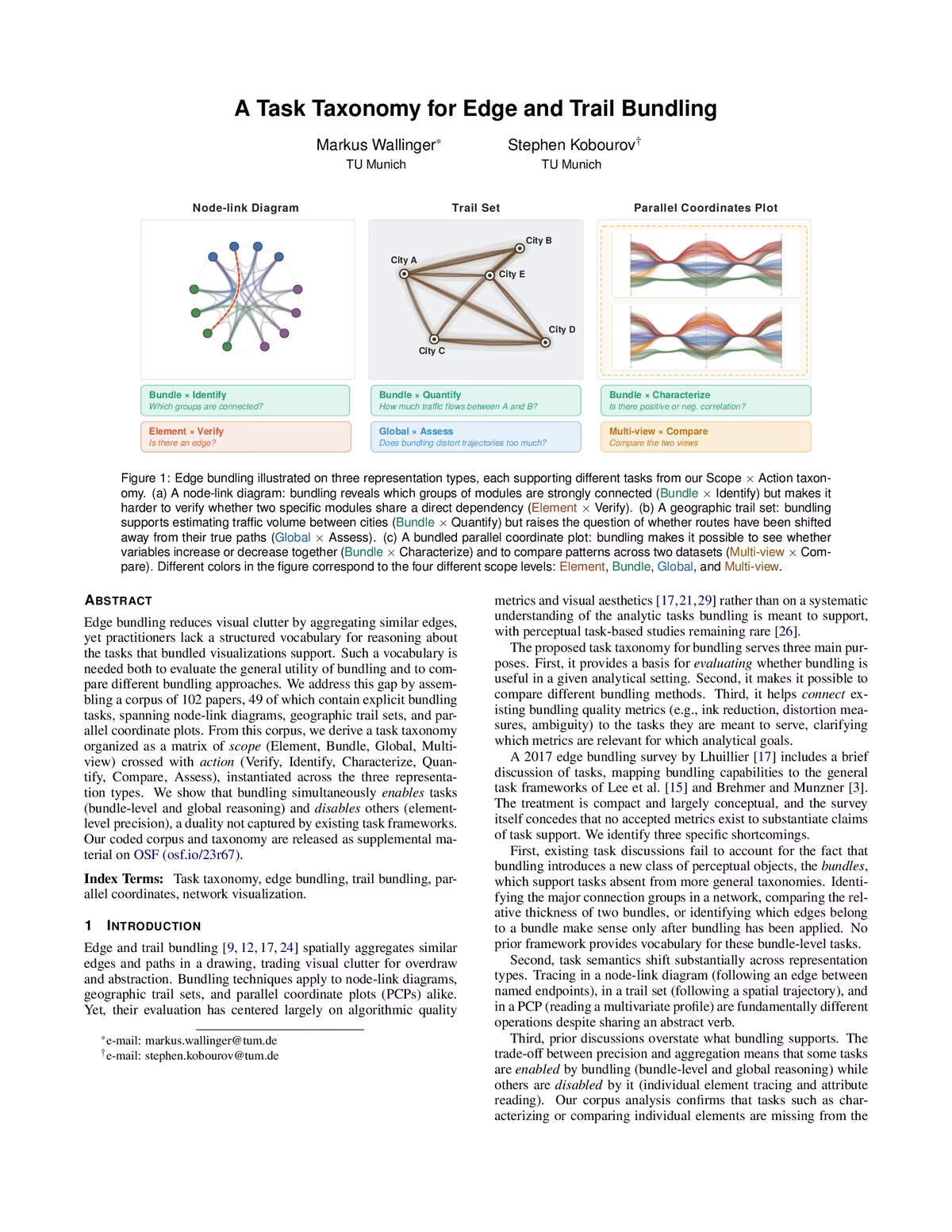
Edge bundling reduces visual clutter by aggregating similar edges, yet practitioners lack a structured vocabulary for reasoning about the tasks that bundled visualizations support. Such a vocabulary is needed both to evaluate the general utility of bundling and to compare different bundling approaches. We address this gap by assembling a corpus of 102 papers, 49 of which contain explicit bundling tasks, spanning node-link diagrams, geographic trail sets, and parallel coordinate plots. From this corpus, we derive a task taxonomy organized as a matrix of scope (Element, Bundle, Global, Multi-view) crossed with action (Verify, Identify, Characterize, Quantify, Compare, Assess), instantiated across the three representation types. We show that bundling simultaneously enables tasks (bundle-level and global reasoning) and disables others (element-level precision), a duality not captured by existing task frameworks. Our coded corpus and taxonomy are released as supplemental material on OSF (osf.io/23r67).
For Practitioners
This paper is for practitioners who build or evaluate network and trajectory visualizations that use edge or trail bundling to reduce clutter: visualization engineers, data scientists working with large graphs or flow data, and domain analysts in traffic, biology, or eye-tracking. They can use the taxonomy to state which tasks a bundled view supports and which it hinders, to spot analytical questions their visualization fails to support, and to choose quality metrics that match the intended task rather than reporting them in isolation.