Loom: Multi-Region Analysis of Spatial Transcriptomics with Local Neighborhoods and Global Trajectories
Siyuan Zhao (University of Illinois Chicago), Md Nafiul Alam Nipu (University of Illinois Chicago ), Hossein Fathollahian (University of Illinois Chicago), Hao Chen (University of Illinois Chicago), Ameen Salahudeen (University of Illinois Chicago), Olga Karginova (University of Illinois Chicago), G. Elisabeta Marai (University of Illinois at Chicago)

Jump to Discussion
Presentation
- Session
- What does it mean to live, anyway?
- Time
- Wednesday, Nov 11, 10:12 – 10:24 (US/Eastern) · session 10:00 – 11:30
- Room
- Hall America center
- Presenting from
- Boston
Links
Sign in to access the Paper PDF.
- Preprint PDF(opens in new tab)
- Supplemental Material(opens in new tab)
Abstract
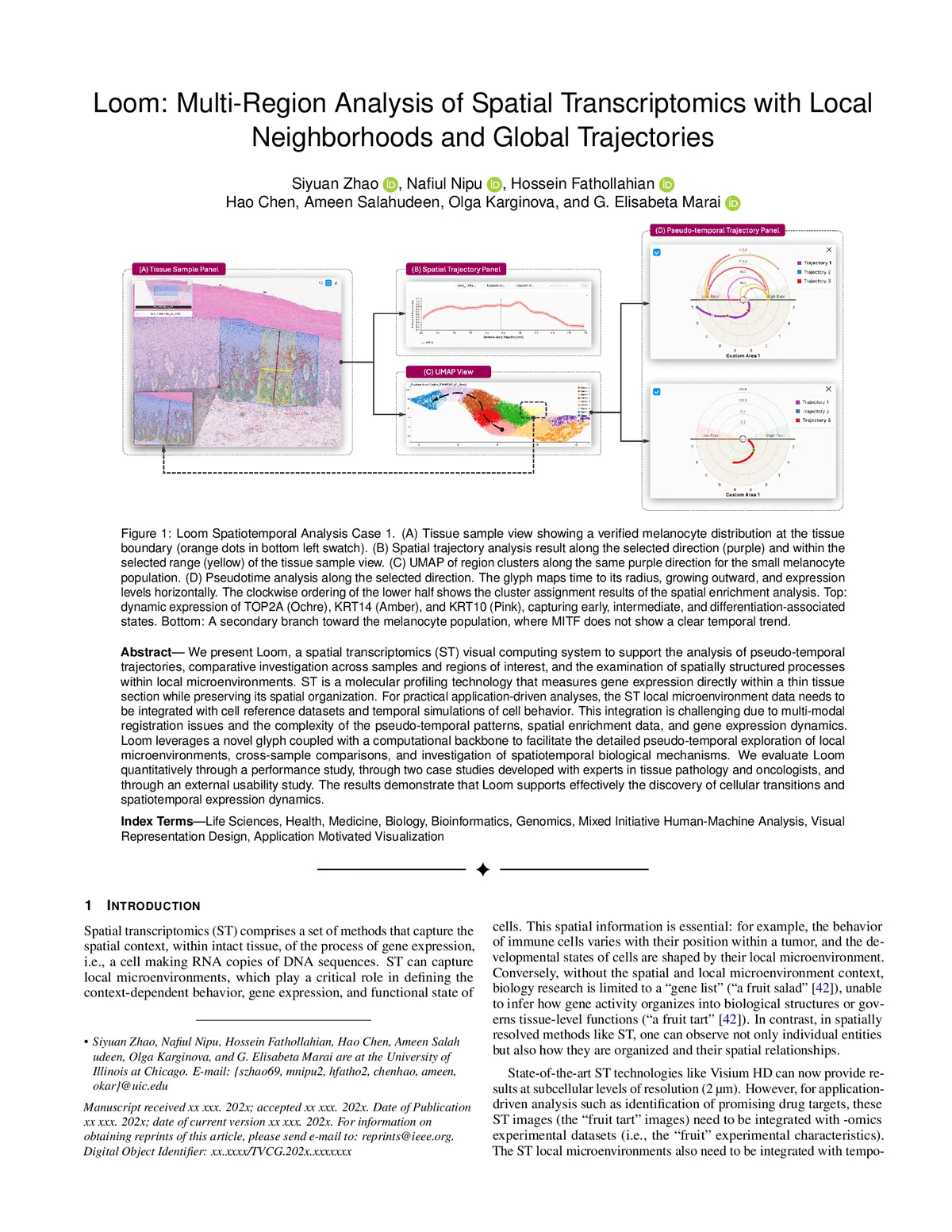
We present Loom, a spatial transcriptomics (ST) visual computing system to support the analysis of pseudo-temporal trajectories, comparative investigation across samples and regions of interest, and the examination of spatially structured processes within local microenvironments. ST is a molecular profiling technology that measures gene expression directly within a thin tissue section while preserving its spatial organization. For practical application-driven analyses, the ST local microenvironment data needs to be integrated with cell reference datasets and temporal simulations of cell behavior. This integration is challenging due to multi-modal registration issues and the complexity of the pseudo-temporal patterns, spatial enrichment data, and gene expression dynamics. Loom leverages a novel glyph coupled with a computational backbone to facilitate the detailed pseudo-temporal exploration of local microenvironments, cross-sample comparisons, and investigation of spatiotemporal biological mechanisms. We evaluate Loom quantitatively through a performance study, through two case studies developed with experts in tissue pathology and oncologists, and through an external usability study. The results demonstrate that Loom supports effectively the discovery of cellular transitions and spatiotemporal expression dynamics.
For Practitioners
Biologists, bioinformaticians, data scientists