Spatial Visual Analytics for Multi-Document Summary Verification
Jiahao Xu (Virginia Tech), Wei Liu (Computer Science, Virginia Tech), Yang Liu (Virginia Tech), Eric Krokos (Department of Defense), Kirsten Whitley (Department of Defense), Xuan Wang (Virginia Tech), Rebecca Faust (Tulane University), Chris North (Virginia Tech)

Jump to Discussion
Presentation
- Session
- I don't trust you, explain yourself!
- Time
- Friday, Nov 13, 08:24 – 08:36 (US/Eastern) · session 08:00 – 09:30
- Room
- Hall Essex north
- Presenting from
- Boston
Links
Sign in to access the Paper PDF.
- Preprint PDF(opens in new tab)
- Supplemental Material(opens in new tab)
Abstract
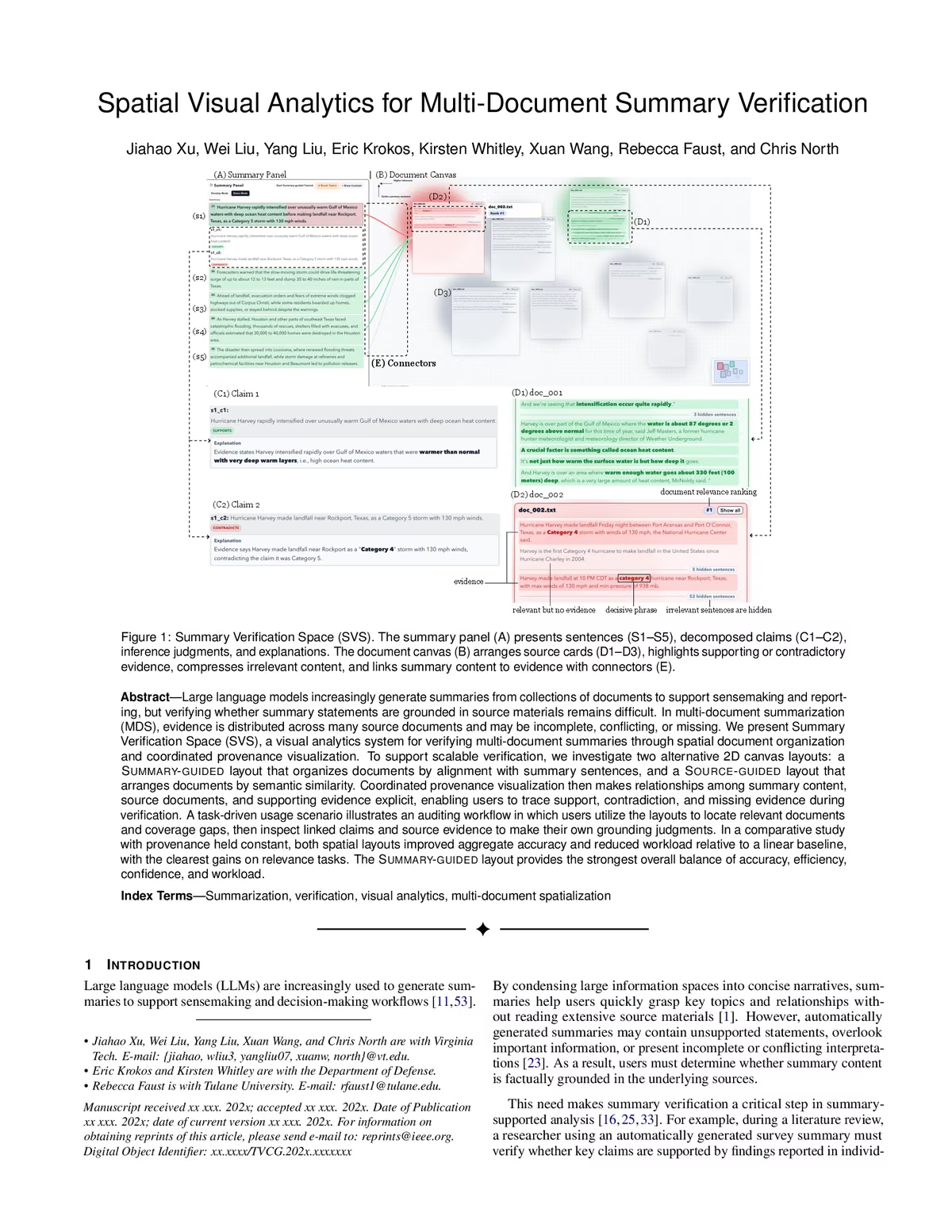
Large language models increasingly generate summaries from collections of documents to support sensemaking and reporting, but verifying whether summary statements are grounded in source materials remains difficult. In multi-document summarization (MDS), evidence is distributed across many source documents and may be incomplete, conflicting, or missing. We present Summary Verification Space (SVS), a visual analytics system for verifying multi-document summaries through spatial document organization and coordinated provenance visualization. To support scalable verification, we investigate two alternative 2D canvas layouts: a SUMMARY-GUIDED layout that organizes documents by alignment with summary sentences, and a SOURCE-GUIDED layout that arranges documents by semantic similarity. Coordinated provenance visualization then makes relationships among summary content, source documents, and supporting evidence explicit, enabling users to trace support, contradiction, and missing evidence during verification. A task-driven usage scenario illustrates an auditing workflow in which users utilize the layouts to locate relevant documents and coverage gaps, then inspect linked claims and source evidence to make their own grounding judgments. In a comparative study with provenance held constant, both spatial layouts improved aggregate accuracy and reduced workload relative to a linear baseline, with the clearest gains on relevance tasks. The SUMMARY-GUIDED layout provides the strongest overall balance of accuracy, efficiency, confidence, and workload.
For Practitioners
Data analysts, journalists, policy researchers, and developers of AI-assisted tools may find this paper useful. They can apply its spatial organization and provenance techniques to locate relevant documents, trace claims to evidence, and verify LLM-generated summaries more efficiently.