What Draws Your Attention First? An Attention Prediction Model Based on Spatial Features in Virtual Reality
Jump to Discussion
Presentation
- Session
- Did you see that? Are you sure?
- Time
- Wednesday, Nov 11, 13:24 – 13:36 (US/Eastern) · session 13:00 – 14:30
- Room
- Hall Essex center
Abstract
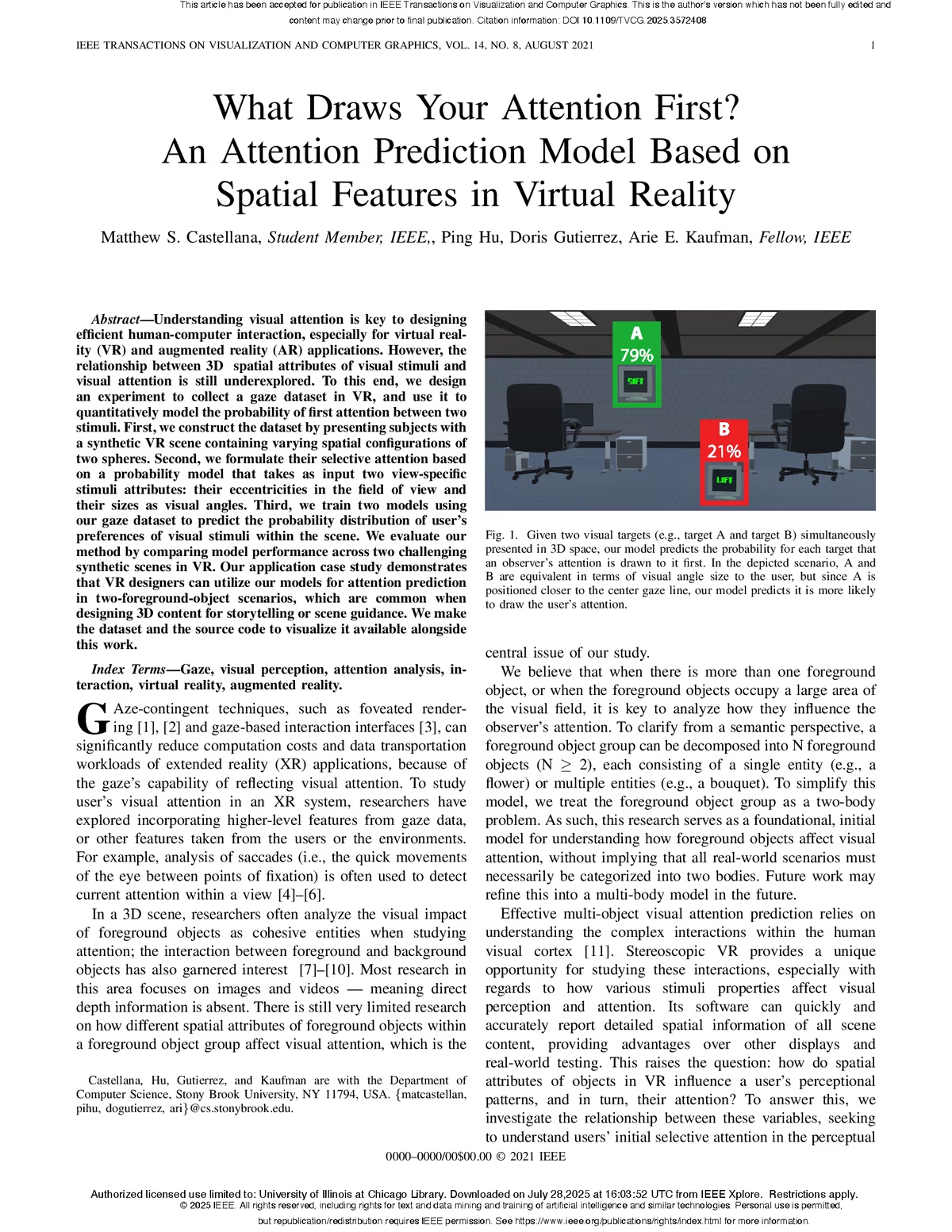
Understanding visual attention is key to designing efficient human-computer interaction, especially for virtual reality (VR) and augmented reality (AR) applications. However, the relationship between 3D spatial attributes of visual stimuli and visual attention is still underexplored. Thus, we design an experiment to collect a gaze dataset in VR, and use it to quantitatively model the probability of first attention between two stimuli. First, we construct the dataset by presenting subjects with a synthetic VR scene containing varying spatial configurations of two spheres. Second, we formulate their selective attention based on a probability model that takes as input two view-specific stimuli attributes: their eccentricities in the field of view and their sizes as visual angles. Third, we train two models using our gaze dataset to predict the probability distribution of a user's preferences of visual stimuli within the scene. We evaluate our method by comparing model performance across two challenging synthetic scenes in VR. Our application case study demonstrates that VR designers can utilize our models for attention prediction in two-foreground-object scenarios, which are common when designing 3D content for storytelling or scene guidance. We make the dataset and the source code to visualize it available alongside this work.